
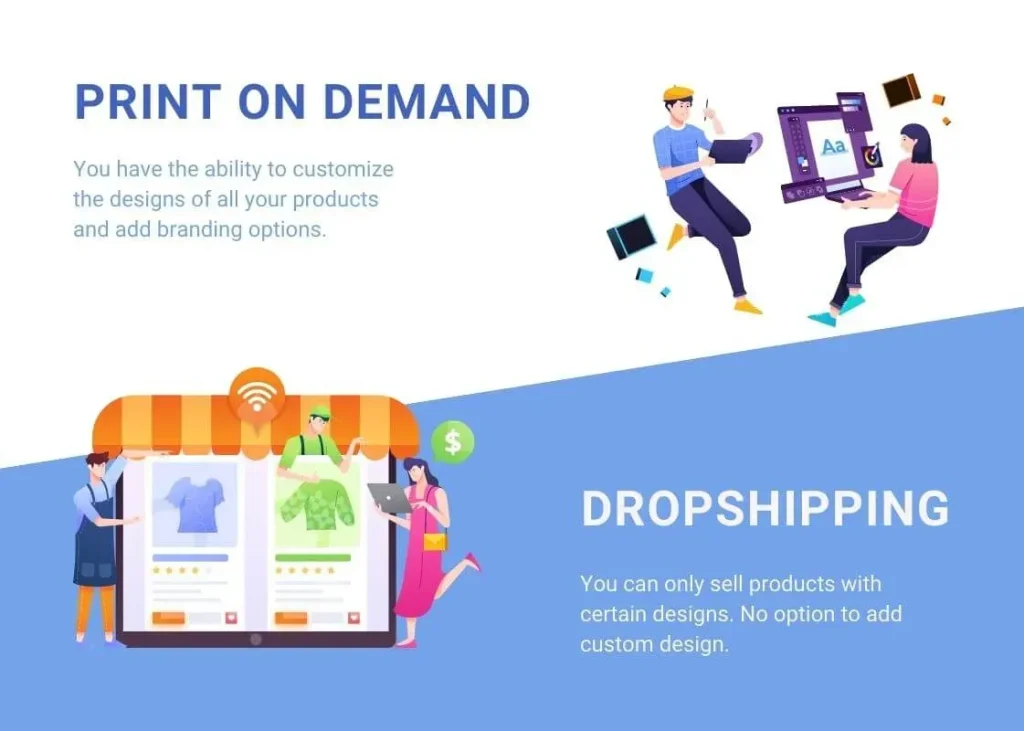
Print on Demand vs Dropshipping is a decision that shapes how a brand scales while keeping capital investments lean in an ecommerce world that demands speed and flexibility. For many businesses, the choice goes beyond price and margins and touches branding, customer experience, and the speed at which products reach the market. The branding potential of on-demand customization lets designers weave a consistent story across apparel, accessories, and home goods, turning customization into a core brand asset. Fulfillment speed and reliability depend on the chosen route and supplier, shaping delivery timelines and the way customers perceive value. To optimize POD profitability, teams should design for value, experiment with bundles, and align pricing with perceived quality rather than chasing volume.
In practical terms, many brands explore a model where custom-printed products are produced after purchase, while others rely on supplier-led fulfillment to extend catalog breadth. This alternative framing – on-demand printing for merchandise versus wholesale-style drop shipping – helps teams compare control over quality, branding, and delivery speed without fixation on upfront inventory. By thinking in terms of flexible production networks, customization-driven branding, and inventory-light logistics, you can map which approach aligns with your market needs.
Print on Demand vs Dropshipping: Beyond Price and Margins
Choosing a distribution model isn’t only about cost per unit or margins. It’s also about how the model aligns with your brand strategy, speed to market, and the overall customer experience. When you explore the print on demand business model against traditional fulfillment, you’ll find that the decision hinges on more than just numbers. This lens helps you assess how quickly you can introduce new designs, how you can protect and grow your brand, and how each approach influences perceived value in your target market.
In this framework, you’ll encounter terms tied to branding, customization, and long-term profitability. The topic of branding with print on demand is central: it’s about building a cohesive brand story across products, packaging, and campaigns. At the same time, you should consider the broader concept of the dropshipping vs POD pros and cons to understand where variability might impact customer trust and repeat purchases. The goal isn’t to choose the cheapest route, but to pick the pathway that sustains brand equity while delivering reliable growth.
Branding with Print on Demand: Crafting a Cohesive Brand Experience
Print on demand unlocks a high degree of branding control. Designers can tailor apparel, accessories, and home goods so each item carries a consistent look, feel, and narrative—from typography to packaging. This alignment extends to limited editions, seasonal drops, and artist collaborations, enabling you to turn product lines into a unified brand story rather than isolated items.
A strong POD branding strategy also supports higher perceived value. By controlling the final presentation, insert messaging, and artwork across products, you reinforce trust and recognition with every unboxing. The ability to scale customized experiences without holding inventory makes the print on demand business model particularly attractive for brands that want to differentiate themselves through design-led storytelling.
Fulfillment Speed: POD vs Dropshipping and Customer Satisfaction
Fulfillment speed is a frontline factor in customer trust. With print on demand, production timelines vary by provider and product type, but many networks offer transparent SLAs and reliable order tracking. Some items may ship quickly in regions with nearby production facilities, while others require additional processing time for customization.
Dropshipping speed depends on supplier location, stock reliability, and carrier choices. Overseas fulfillment can introduce longer transit times, while domestic suppliers may offer expedited options. When evaluating speed, map worst-case and average delivery windows, then communicate realistic expectations to customers to preserve satisfaction and reduce post-purchase anxiety.
Costs, Margins, and Profitability: Optimizing POD and Dropship Economics
The cost structure of print on demand centers on per-item production and fulfillment fees, often with a premium for customization. This can lead to higher base costs, but it also provides opportunities to command premium pricing through design, exclusivity, and branding.
In contrast, dropshipping generally offers lower upfront costs and a wider catalog, which supports rapid experimentation. However, margins can be thinner and more sensitive to shipping surcharges and stockouts. To sustain POD profitability, consider design optimization, bundling, and exclusive designs that drive higher perceived value while keeping fulfillment costs in check.
Implementation Playbook: A Practical Plan to Decide, Pilot, and Scale
A practical implementation starts with aligning your brand positioning and design guidelines to whichever fulfillment path you pursue. Create a brand book that standardizes typography, color, packaging, and artwork so your POD or dropship products remain on-brand across channels. This ensures consistency as you scale and introduces less friction when onboarding new design assets.
Next, vet partners with a focus on quality, reliability, and integration. Build product descriptions that clearly communicate benefits and expectations, and experiment with pricing and bundles to test what resonates. A thoughtful pilot—testing POD lines alongside a small dropship catalog—can reveal real-world performance differences in your target markets, helping you determine the best long-term balance for your brand.
Frequently Asked Questions
Print on Demand vs Dropshipping: what is the core difference in the print on demand business model compared to dropshipping?
In the print on demand business model, products are produced after an order is placed, enabling high customization, full branding control, and minimal upfront inventory. However, per‑unit costs are typically higher and production can add lead time. Dropshipping lets you offer a broad catalog with low upfront risk, but you sacrifice some control over product quality, packaging, and delivery times since fulfillment is handled by the supplier.
Branding with Print on Demand vs Dropshipping: what are the pros and cons?
Branding with Print on Demand shines through precise artwork, packaging, and inserts, allowing limited editions and cohesive brand storytelling. POD pros include strong customization, consistent branding, and higher perceived value; cons include longer production timelines and higher unit costs. Dropshipping offers breadth and speed to market but comes with cons like less branding control, potential quality and packaging variability, and more supplier coordination.
Fulfillment speed POD vs Dropshipping: how do they compare and what should brands expect?
Fulfillment speed depends on the network and geography. POD timelines usually involve a production window (often 3–7 days) plus shipping, with some networks offering expedited options. Dropshipping speed hinges on the supplier’s location and stock reliability; overseas sources can add transit time, while domestic suppliers may enable faster delivery. To manage expectations, set clear SLAs and communicate accurate shipping estimates.
Is Print on Demand profitability strong compared to Dropshipping, and how can you improve POD profitability?
POD profitability can be competitive, especially when you price based on value and leverage customization. POD often has higher per‑unit costs but can maintain strong margins with premium designs and effective bundles. Improve POD profitability by optimizing design choices, offering exclusive or limited editions, using product bundles to raise average order value, and carefully managing fulfillment costs and pricing strategy.
Print on Demand vs Dropshipping: in what scenarios should a brand choose POD, dropshipping, or a hybrid approach?
Choose POD when branding, customization, and a cohesive unboxing experience are priorities, and you can justify higher unit costs with perceived value.Choose dropshipping when you want a broader catalog, faster market testing, and lower upfront investment. A hybrid approach often works best: core POD products reinforce branding and margins, while dropship items expand catalog and enable trend testing.
| Aspect | Print on Demand (POD) | Dropshipping |
|---|---|---|
| Model overview | Products produced after order; no inventory risk; highly scalable for customized/art-driven products; partner with a POD provider handling printing, production, and shipping. | Products listed from one or more suppliers who ship directly to customers; you manage storefront and customer relationships; supplier handles inventory and fulfillment; enables broader catalog. |
| Key advantages | Customization, branding flexibility, low upfront risk. | Breadth of selection, speed to market. |
| Trade-offs & considerations | Longer production timelines and potentially higher per-unit costs; margins depend on pricing strategy. | Less control over product quality and packaging; potential stockouts; longer shipping times if overseas; margins thinner. |
| Branding & customer experience | Strong branding control through customizable packaging and inserts; ability to offer limited editions and cohesive brand storytelling. | Branding possible but unboxing and presentation depend on supplier; may require branding add-ons for cohesion. |
| Costs, margins & profitability | Production costs per item; higher base price due to customization; potential for premium pricing; profitability via design choices, upsells, bundles. | Lower upfront costs; wider product range; margins thinner and more sensitive to shipping costs and supplier fees/stockouts. |
| Fulfillment speed & reliability | Production + shipping timelines; some networks offer overnight production for certain products/regions; plan with clear SLAs and tracking. | Speed depends on supplier location, stock reliability, and carriers; possible expedited options but longer processing if from overseas. |
| Use-case scenarios | Best for high customization, art-driven designs, limited editions, and branding-focused launches. | Best for broad catalogs, rapid iteration, and low upfront risk; good for testing demand and expanding SKUs quickly. |
| Decision framework (8 questions) | Key questions include: customization vs breadth; packaging importance; target regions/shipping; design resources; margins vs upfront investment; supplier relationships and quality control; branding focus (editions vs evergreen); scaling plans. | If most answers favor breadth, quick iterations, and low upfront risk, dropshipping may be preferable; if customization, branding, and control are priorities, POD is likely a better fit. Consider a short pilot to compare performance. |
| Implementation steps (summary) | Define brand positioning and design guidelines; choose trusted POD and/or dropshipping partners; craft clear product descriptions; test pricing and bundles; monitor performance; plan for scale. | Follow the same steps with an emphasis on ensuring consistent branding across the chosen model and maintaining reliable supplier relationships; iterate based on data. |
Summary
Conclusion