
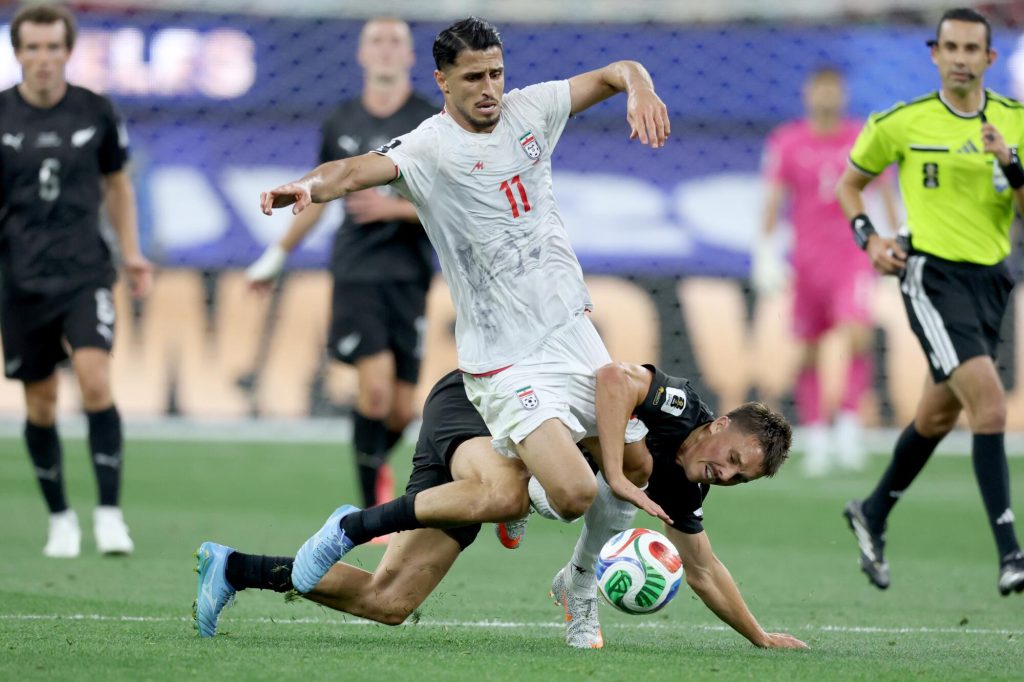
An upset against Iran was nearly achieved by a highly disciplined New Zealand side on Monday night as Darren Bazeley’s All Whites secured a dramatic 2-2 draw in their World Cup Group G opener at SoFi Stadium. Despite entering the match as massive underdogs, the lowest-ranked qualifiers in the tournament executed a near-flawless counter-attacking masterclass that twice exposed the heavy defensive lines of Team Melli. To stay informed on the latest tactical reviews and group-stage updates, explore our comprehensive coverage in our World Cup analysis category.
Table of Contents
The tactical battle in Inglewood unfolded before a highly vocal, partisan crowd that heavily backed the Iranian national team. Recognizing their structural and technical disadvantage, the New Zealand coaching staff designed a highly pragmatic game plan focused on defensive compactness and vertical transitions. The execution of this blueprint pushed one of Asia’s most feared teams to their absolute limit.
1. The Mid-Block Strategy: Laying the Groundwork for an Upset Against Iran
Darren Bazeley set up the All Whites in a rigid, low-intensity 4-5-1 mid-block that focused on denying central space to Iran’s playmakers, Mehdi Taremi and Alireza Jahanbakhsh. Midfielders Marko Stamenic and Matthew Garbett worked tirelessly to clog the half-spaces, forcing Team Melli to circulate the ball harmlessly across their backline. By squeezing the distance between their defensive and midfield lines, Bazeley’s side created the perfect platform to hunt for an upset against Iran.
According to the World Cup analysis by The Guardian, Iran’s possession reached nearly 58%, yet they struggled to generate high-quality opportunities in the central box during the opening half-hour. This defensive structure prevented Iran’s dangerous wingers from finding isolated one-on-one scenarios against New Zealand’s full-backs. The All Whites showed maturity by maintaining their shape even under intense periods of sustained pressure.
As the match progressed, this tactical discipline allowed New Zealand to conserve valuable energy under the heavy stadium lighting. The frustration within the Iranian ranks grew visible, leading to rushed passes and turnover vulnerabilities in the middle third.
2. Chris Wood’s Target Play: Key to the Upset Against Iran
The tactical success of New Zealand’s direct transitions depended heavily on the hold-up play of Nottingham Forest striker Chris Wood. Wood acted as the ultimate target man, constantly contesting aerial duels against Shoja Khalilzadeh and winning vital second balls. Wood’s physical dominance over Iranian defenders was essential to making the dream of an upset against Iran a realistic possibility.
In-depth player data from Sofascore confirmed that Wood completed both assists for Eli Just’s goals, demonstrating his elite vision under pressure. In the 7th minute, Wood held off two defenders before sliding a perfectly weighted pass into the path of the oncoming winger. His physical presence forced Iran’s central defenders to drop deeper, creating massive pockets of space for New Zealand’s central midfielders to exploit.
His second assist in the 54th minute was equally sublime, as he executed a quick flick-on during a rapid transition. Wood’s performance illustrated the immense value of a traditional target striker in modern counter-attacking setups.
3. Eli Just’s Clinical Finish: Driving the Upset Against Iran
While Chris Wood provided the physical leverage, winger Eli Just provided the clinical finishing required to convert half-chances into historic goals. Just’s intelligent diagonal runs behind Iran’s high defensive line caught the center-backs flat-footed on multiple occasions. With New Zealand executing their vertical passes at breakneck speed, the prospect of a historic upset against Iran grew stronger with every break.
As noted by CNA, New Zealand coach Darren Bazeley expressed immense pride in his squad’s clinical edge, stating that their quality performance proved they belong on the world stage. Just’s second goal, a sliding finish past Iran’s goalkeeper in the 54th minute, was a testament to his tracking work rate. Only a spectacular 30-yard masterclass from Iranian veteran Ramin Rezaeian prevented the All Whites from walking away with all three points.
“We showed that when we play with belief and stick strictly to our tactical transitions, we can compete with any team in this tournament,” stated New Zealand head coach Darren Bazeley during his post-match press conference.
4. Tactical Dimension: Low Block vs. Possession Hegemony
This tactical matrix highlights the team metrics that defined the close push for an upset against Iran at SoFi Stadium. The statistics outline the stark differences in tactical execution between the two contrasting systems.
| Tactical Element | Iran (Possession & High Press) | New Zealand (Low-Block Counter) |
|---|---|---|
| Primary Formation | 4-3-3 (Attacking width) | 4-5-1 (Midfield density) |
| Pass Completion Rate | 83% (Slow build-up) | 74% (Direct, vertical transitions) |
| Deep-Third Recoveries | 12 (High defensive recovery) | 27 (Low defensive recovery block) |
| Conversion Rate | 14.2% (14 shots, 2 goals) | 22.2% (9 shots, 2 goals) |
5. Frequently Asked Questions (FAQ)
How did New Zealand almost pull off an upset against Iran?
New Zealand utilized a highly organized 4-5-1 mid-block, direct vertical balls to target striker Chris Wood, and clinical diagonal runs by Eli Just, nearly enabling a massive upset against Iran.
Who were the standout tactical performers in the push for an upset against Iran?
Chris Wood, who recorded two brilliant assists, and Eli Just, who scored twice, remained the central architects of the bid for an upset against Iran.
What are New Zealand’s chances of progressing in Group G?
With all four Group G teams currently locked on one point, New Zealand stands in an excellent position to fight for a knockout spot in the aftermath of their close pursuit of an upset against Iran.